Can’t we just call it mpk? Why EV efficiency only needs three letters – not six and a forward-slash
There was a time when working out how efficient your car was required little more than basic numeracy and the ability to remember three letters: mpg.
Miles per gallon. Simple. Elegant. Universal. Everyone knew what it meant. Your mate’s car did 28 mpg. Yours managed 35. The bloke down the pub swore his diesel did “nearly 60 on a run.” You didn’t need a spreadsheet or a physics degree to understand whether that was good or not.
Now, however, we find ourselves in the electrified future, and suddenly efficiency has become… complicated.
Manufacturers, regulators and assorted clever people have presented us with a bewildering collection of units: kWh per 100 kilometres, kWh per 100 miles, miles per kilowatt-hour, and a few other variations that seem designed to test whether the public was paying attention in their GCSEs.
Trouble is, most people weren’t.
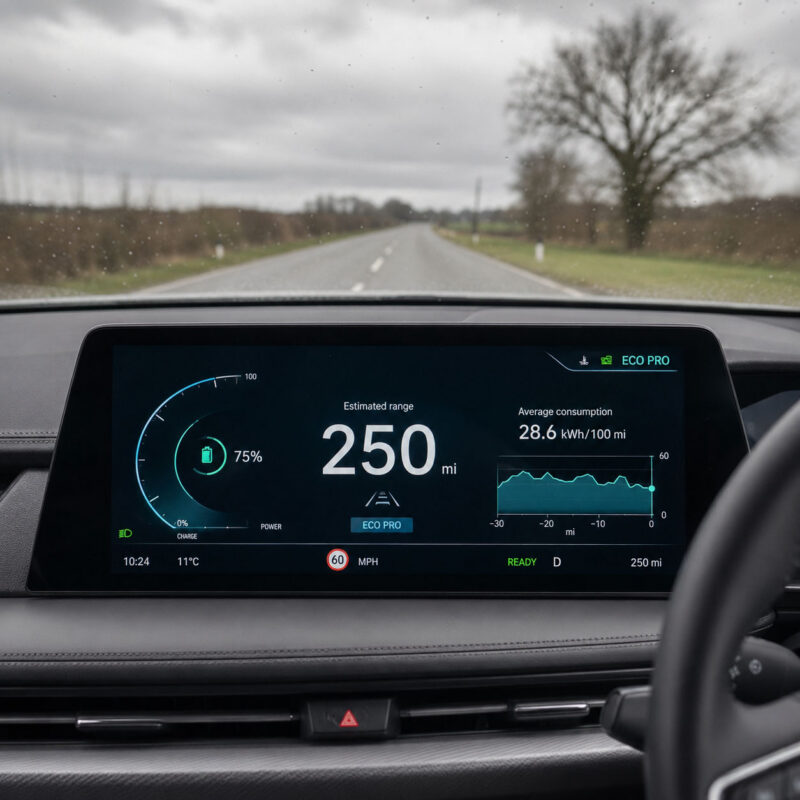
Take “20 kWh/100 kilometres”. Is that good? Is it terrible? Is it the electric equivalent of a V8 Range Rover towing a caravan uphill into a headwind? Or is it more like a Toyota Prius slipstreaming an Asda lorry round the M25?
For most people who aren’t early-adopters or EV-evangelists, the honest answer is: who the hell knows?
Even the slightly friendlier “miles per kilowatt-hour” isn’t much better. And when abbreviated to “mpkWh” it still doesn’t fit on the average dashboard, looks like a terrible Scrabble hand, and no-one can remember if it’s capital ‘K’ or capital ‘W’.
Besides, is three em-pee-kay-double-you-aitch excellent, or is it awful? Without context, it’s just a number attached to a unit nobody can visualise, let alone pronounce.
Perhaps that’s the real issue: a kilowatt-hour is an utterly intangible thing.
Ask someone to picture a gallon and they probably can. It’s a jerry can of petrol. It’s a container you can hold, pour, spill, and smell. Americans have been using it to measure everything from fuel to cowboy hats for generations. But ask someone what a kilowatt-hour looks like and you’ll get a blank stare.
You can’t see it. You can’t pour it into a lawnmower. You can’t carry it across the garage in a red plastic can while trying not to slosh it on your shoes. It exists entirely in the abstract world of electricity meters and energy bills.
Which makes it a rather poor unit for helping ordinary motorists understand efficiency.
So perhaps it’s time for a bit of simplification.
Instead of asking everyone to juggle kWh per 100 kilometres, kWh per 100 miles, or miles per kilowatt-hour, why not just settle on something short, memorable and familiar?
Call it mpk.
Yes, technically it’s still derived from miles per kilowatt-hour. But the important thing is the presentation. Three letters. Nice and tidy. A car that does 4 mpk is better than one that does 3 mpk. Simple.
You don’t need to know what a kilowatt-hour looks like. You don’t need to kilometres into miles. Just compare the number. Bigger is better. Job done.
It’s also comfortingly familiar. Drivers have spent decades subconsciously judging cars by mpg. Swapping the ‘g’ for a ‘k’ doesn’t require a complete re-education of the motoring public. It’s evolution, not revolution. And it’s a step that takes car buyers along for the ride, rather than dropping them in front of an alien readout on their dash.
It even rolls off the tongue nicely. Say it: em pee kay.
Of course, somewhere out there a standards committee would immediately object that this isn’t technically correct. There would be discussions about SI units, harmonisation, regulatory frameworks and the correct representation of electrical energy.
And that’s precisely the sort of conversation that caused this mess in the first place.
The average driver doesn’t care about unit harmonisation. They just want to know whether one car goes further than another on the same amount of energy. Or if their attempts at being economical with the electrons by turning off the aircon and sacrificing the radio for a week made a difference or not. A simple comparison, with no mental gymnastics required.
For generations, mpg did that job perfectly. Perhaps mpk can do the same for the electric age.
Wouldn’t that be progress.
Looking for automotive PR support?
If you’re looking for people who understand the industry, the media and the moving parts behind a good story, we should talk.
Talk to loop