Has the bottom fallen out of the classic car market?
In the aftermath of the pandemic, the classic car market seemed to take on a viral behaviour all of its own. Modern classics, even those previously unloved by buyers, found themselves sweeping through auctions at vastly inflated hammer prices as people looked to the past and happier times.
But today those same cars are struggling to find homes, while those that do sell are falling well short of even their lowest estimate. This has led to suggestions that the market has collapsed, and that interest in classic cars has somehow fallen by the wayside.
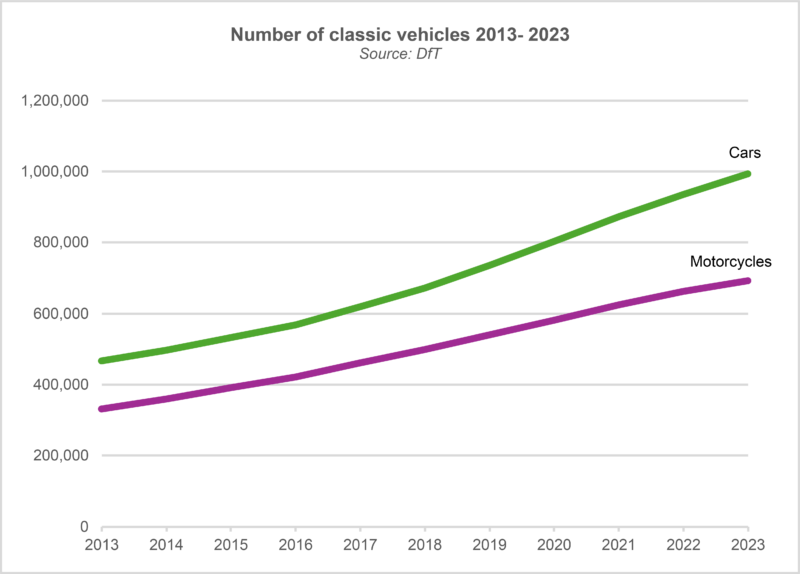
From whichever angle you look at the numbers, there are now more classics on our roads than ever before. In fact, the number of classic cars registered in the UK[1] has more than doubled since 2013, rising from 466,830 back then to 993,140 by the end of last year. The number of classic motorcycles has doubled, too, up from 332,211 in 2013 to 692,360 in 2023. That’s quite an increase, and the rate at which those numbers have been rising has also doubled (in the case of cars, at least) over the same period.
Much of the recent growth in the classic market had been driven by millennials snapping up a youngtimer that resonated with their youth. Although the impact of this had been to push up prices of even the most modest examples of our motoring history, this rise in value has also had another effect: with classics worth more, the point at which an old car or bike becomes worth saving is now much easier to reach. As a result, ‘average’ cars that would have previously found themselves on the scrapheap have been rescued, fettled, and preserved for a new generation.
Two ends of the spectrum
There had been unprecedented growth at the other end of the market, too, with rising numbers of investors turning to classic cars as a means of diversifying their portfolio by adding a touch of passion to their collection.
Jump in to your DeLorean and travel back in time to the mid-1970s and you’d be able to pick up a 1961 Ferrari 250 GT SWB California Spyder – the car made famous after it careered out of its glass garage in Ferris Bueller’s Day Off – for just $16,750. If you had the plutonium for it, you could roll the time circuits back further to 1964 and find the same car listed for sale in Road & Track for just $10,500. These numbers sound almost fanciful now. But perhaps not as fanciful as the $4.95 million[2] the very same car made at auction in 2009.
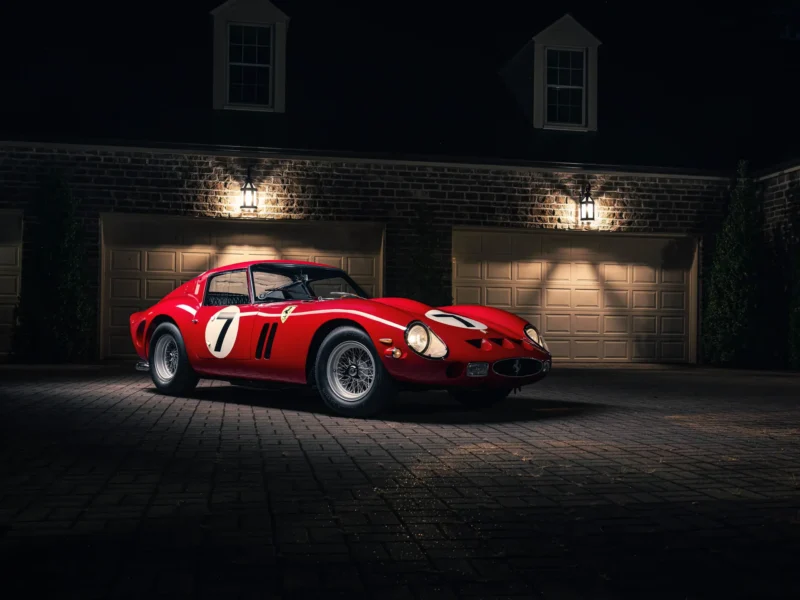
A similar slice of Ferraricana found itself setting the record for the most expensive auction sale of last year when a 1962 Ferrari 330 LM/250 GTO reached $51.7 million[3]. But even that isn’t enough to eclipse the eye-watering figure achieved by a Mercedes-Benz 300 SLR Uhlenhaut Coupe – one of only two ever made – which sold for €135 million[4] in 2022.
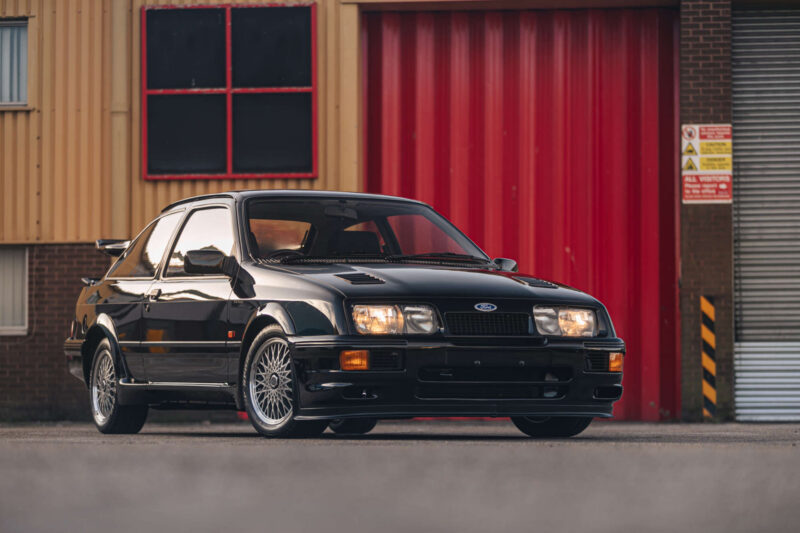
This 1987 Ford Sierra Cosworth RS500 sold for £590,500 at auction in 2023
This, it’s clear, is a whole other world. One where cars are bought and sold solely as objects of investment, destined to live out their lives as line-items on a balance sheet somewhere, never to turn a wheel. While this has tended to be the preserve of the wealthy and traditionally confined to the likes of Ferraris and rare Aston Martins, the near-£600,000 auction sale[5] of a Sierra RS500 Cosworth demonstrates that attention is beginning to turn to new opportunities within the market. Some have even turned it into a business.
The Knight Frank Luxury Investment Index[6] shows that investments of passion are still riding high, although after the record-breaking performances of previous years, the latest results show that some instability is now creeping in to the market. In the 10-year period to 2022, investment-grade cars rose in value by 185%, placing them well ahead of traditional collectables such as art and watches, and ranking them second only to rare whiskies. Even during 2022, cars were still outperforming everything but fine art with a 25% year-on-year increase.
But last year, cars fell by 6%, making them the second-worst performer and slashing their 10-year return to 82%.
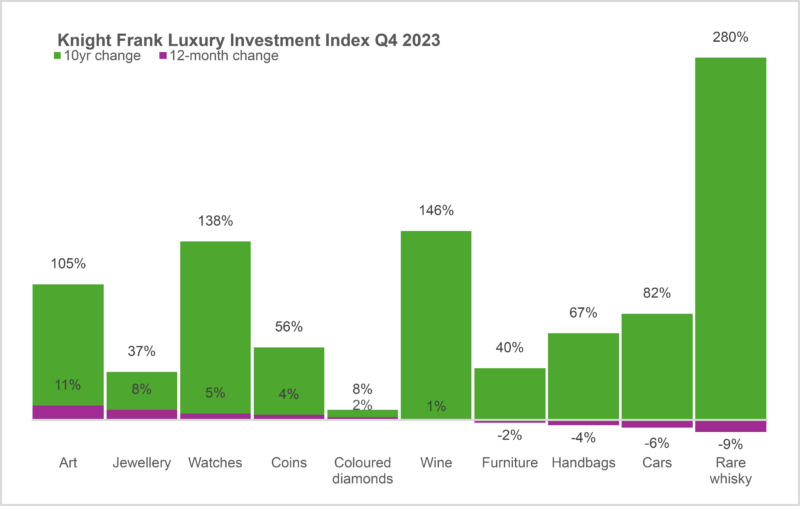
Yet despite this apparent fall from grace, interest remains strong. Attitudes vary by region, but 43% of North American wealth advisors report that their clients are increasingly interested in classic cars, more than any other passion investment. Fine art and watches are favoured by European investors, but classic cars were still cited a close third (along with fine wines) with 39% declaring a rising interest.
The market has cooled, but not crashed
Sale rates and values have undoubtedly fallen during this summer, with 40% of the models covered in the UK Hagerty Price Guide and 35% in the US guide having dropped in value, both of which are unprecedented figures.
“Rising interest rates, a higher cost of living, and the uncertainty caused by pending governmental elections both in the UK and US encouraged people to be careful with their money,” explains John Mayhead, Hagerty Price Guide UK Editor. “That, and some of those who had bought classic cars on impulse after the pandemic decided that they had scratched that itch and put their cars on the market.”
While these forces have certainly led to a cooling in the market, their long-term impact is likely to be limited. The market’s seasonal shutdown may start a little sooner, as canny sellers decide to hang on to their cars a little longer and ride-out this uncertain autumn. There are signs that the market may already be stabilising, but by the spring, Labour’s fiscal direction of travel will have been revealed, a new president will be in the White House, and a clearer picture will emerge.
The surge in demand that followed the pandemic is increasingly fading into memory, too, relegated to a quirk in the data that will live on in the history books and as a spike in the charts. The very best examples continue to command a premium, but misty-eyed sellers still wanting ‘covid money’ for average cars are likely to find themselves up against a market that has already corrected itself.
[1] Department for Transport, df_VEH0124: Vehicles at the end of the year by licence status, body type, make, generic model, model, year of first use and year of manufacture: United Kingdom
[2] Sports Car Digest, Ferrari 250 GT SWB California Spyder – Classic Cars for Sale
[3] RM Sotheby’s, 1962 Ferrari 330 LM/250 GTO by Scaglietti
[4] RM Sotheby’s, 1955 Mercedes-Benz 300 SLR ‘Uhlenhaut Coupé’
[5] Silverstone Auctions, Race Retro Classic and Competition Car Sale 2023, 1987 Ford Sierra Cosworth RS500
[6] Knight Frank, Wealth Report 2024
Looking for automotive PR support?
If you’re looking for people who understand the industry, the media and the moving parts behind a good story, we should talk.
Talk to loop